



Coffee Plantations in Chikkamagalur – Exploring the Heart of India’s Coffee Country
When people think of Chikkamagalur, they often picture mist-covered hills,…

 43 Views
Bhadra Wildlife Sanctuary is where Chikkamagalur’s quiet hill-town charm gives way to raw wilderness. While many visitors come to coffee country for scenic plantations and mountain viewpoints, those who venture a little further discover something far more primal — a protected forest landscape alive with rivers, wildlife, and untamed beauty.
Located along the Western Ghats, Bhadra Wildlife Sanctuary is one of Karnataka’s most significant ecological reserves. Spread across dense deciduous forests, grasslands, and riverine ecosystems, the sanctuary offers travellers an immersive encounter with nature that feels vastly different from plantation tourism. Here, instead of coffee trails and café stops, you find safari routes, bird calls echoing through trees, and the distant possibility of spotting a tiger.
For nature lovers, photographers, wildlife enthusiasts, and travellers seeking something beyond the ordinary, Bhadra Wildlife Sanctuary is one of the most rewarding places to visit near Chikkamagalur.
Bhadra Wildlife Sanctuary is situated approximately 35 to 40 kilometers from Chikkamagalur town, making it an ideal half-day or full-day excursion. The sanctuary spans parts of Chikkamagalur and Shivamogga districts and covers over 490 square kilometers of forested terrain.
Named after the Bhadra River that flows through it, the sanctuary forms part of the Western Ghats biodiversity hotspot — one of the world’s most ecologically rich regions. Its location between mountain ranges and river valleys makes it uniquely diverse in both landscape and wildlife.
The most popular access point for visitors is the Muthodi range near Chikkamagalur, which offers organized jeep safaris and controlled entry for tourists.
One of the first things you notice when entering Bhadra Wildlife Sanctuary is the density of the forest. The air feels cooler, heavier with moisture and the scent of earth. Tall teak, rosewood, and honne trees form towering natural canopies that filter sunlight into scattered beams across the forest floor. Bamboo clusters line the dirt tracks, swaying gently in the breeze. The ground is layered with fallen leaves, roots, and undergrowth that hint at decades — even centuries — of uninterrupted growth.
The terrain shifts subtly as you move deeper into the sanctuary. Some stretches are thick woodland where visibility narrows and shadows stretch longer. Other areas open into grassy clearings where deer and gaur graze cautiously. Rolling hills rise in the distance, adding depth to the landscape and reminding visitors that this reserve sits within the Western Ghats, one of India’s most ecologically significant mountain ranges.
The Bhadra River adds another dynamic element to the ecosystem. Flowing steadily through parts of the sanctuary, it nourishes surrounding vegetation and sustains wildlife throughout the year. During drier months, animals are often spotted near the riverbanks, drawn by dependable water sources. The river also supports aquatic species and contributes to the rich biodiversity of the region.
Unlike manicured national parks designed for predictable sightings, Bhadra remains wild and largely untouched. There are no artificially created viewing zones or staged wildlife experiences. The forest does not feel curated for tourism. It feels ancient and alive — governed by natural rhythms rather than visitor schedules.
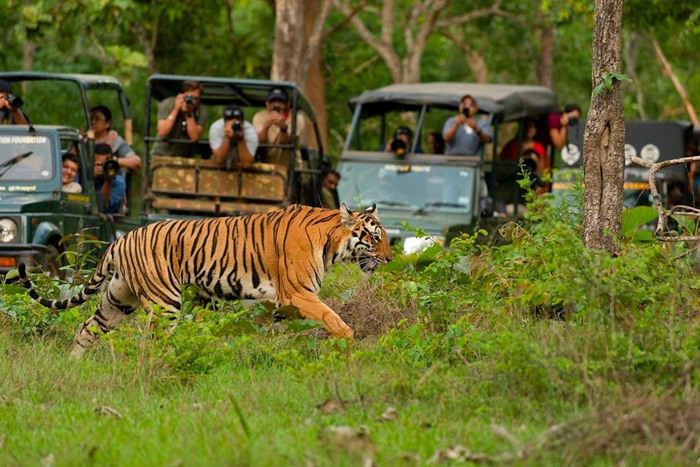
Bhadra is officially classified as a Tiger Reserve, and although tiger sightings are rare and never guaranteed, the possibility alone adds anticipation to every safari. The sanctuary supports a balanced predator-prey ecosystem, which is why it remains an important conservation zone within Karnataka.
Beyond tigers, Bhadra Wildlife Sanctuary is home to a remarkable range of mammals. Leopards occasionally move silently through the forest. Sloth bears roam in search of insects and fruit. Indian gaurs — often referred to as bison — are among the most impressive animals to encounter, standing tall and powerful in open clearings. Sambar deer and spotted deer are more commonly sighted, often grazing in herds. Wild boars root through undergrowth, while langurs and macaques leap between tree branches overhead.
Elephants are among the more frequently spotted large animals, especially during certain seasons when herds migrate across the reserve. Seeing a herd move through forest pathways — calves protected between adults — is one of the sanctuary’s most memorable sights.
Birdwatchers consider Bhadra Wildlife Sanctuary a true treasure trove. With over 250 recorded bird species, the sanctuary attracts both amateur and serious birding enthusiasts. Crested serpent eagles circle high above treetops. Malabar trogons flash brilliant colors against green backdrops. Hornbills glide between trees with unmistakable silhouettes. Peafowl, kingfishers, drongos, and woodpeckers add constant movement and sound to the forest.
Reptiles such as pythons, cobras, and monitor lizards inhabit the reserve as well, though sightings depend heavily on timing and luck. Even insects, butterflies, and smaller forest dwellers contribute to the sanctuary’s vibrant ecological network.
The primary way to explore Bhadra Wildlife Sanctuary is through guided jeep safaris organized by the Forest Department. Private vehicles are not permitted inside the core areas, a rule that protects wildlife habitats and maintains ecological balance.
Safaris generally operate twice daily — early morning and late afternoon. Morning safaris begin just after sunrise, when the forest is at its most active. Cooler temperatures encourage animal movement, and golden light filters beautifully through trees. Evening safaris, on the other hand, offer dramatic lighting and opportunities to spot animals emerging from shaded areas into open grasslands.
As your jeep moves slowly along designated forest tracks, the atmosphere shifts from casual to attentive. The sound of the engine becomes secondary to forest noise — bird calls, rustling leaves, distant animal movements. Guides are trained to notice subtle clues: fresh pugmarks in mud, broken branches indicating recent passage, or alarm calls from deer that signal predator presence.
Every turn carries anticipation. A herd of deer may appear suddenly. A peacock might cross the path. A distant gaur could stand partially hidden behind trees. Even when large predators remain unseen, the safari experience itself feels immersive. It demands patience and awareness, encouraging visitors to observe rather than rush.
The slow pace enhances appreciation. This is not a zoo; it is a living ecosystem.
The ideal time to visit Bhadra Wildlife Sanctuary is between October and March. Post-monsoon months leave the forest lush and vibrant, while temperatures remain comfortable for extended safaris. Visibility improves as foliage settles, and wildlife activity remains steady.
During the monsoon season from June to September, the sanctuary transforms dramatically. Heavy rainfall turns the landscape deep green, rivers swell, and mist often blankets the forest. While the scenery becomes breathtaking, safari operations may occasionally be limited due to road conditions or safety considerations.
Summer months from April to May bring warmer temperatures, but they also increase wildlife visibility in certain areas. As water sources shrink, animals congregate near rivers and reservoirs, potentially improving sightings. However, midday heat can be intense, making early morning safaris especially important.
Regardless of season, early mornings consistently provide the best combination of cooler temperatures, active wildlife, and ideal lighting.
Bhadra Wildlife Sanctuary offers exceptional opportunities for photography, particularly for those interested in wildlife and landscape imagery. The interplay of light and shadow within dense forest settings creates naturally dramatic compositions. Morning light filtering through tree canopies produces golden hues that elevate even simple frames.
Open grasslands provide contrast to wooded areas, allowing photographers to capture animals against expansive backgrounds. The presence of the Bhadra River adds reflective surfaces and dynamic foreground elements.
Birdwatchers find the sanctuary especially rewarding. Patient observation often leads to sightings of vibrant species perched high in tree branches. Listening carefully for distinct calls can guide your lens upward toward hidden movement. Because bird activity peaks early in the day, sunrise safaris are particularly valuable for avian photography.
Visitors should carry telephoto lenses, extra batteries, and memory cards. Respecting distance guidelines ensures both safety and ethical wildlife interaction.
Bhadra Wildlife Sanctuary represents one of Karnataka’s most significant conservation achievements. Declared a protected area decades ago and later designated as a Tiger Reserve, the region has benefited from structured conservation policies and habitat restoration initiatives.
One notable effort involved relocating villages from core forest zones to reduce human-wildlife conflict. This relocation allowed ecosystems to regenerate naturally, increasing wildlife populations and improving ecological balance.
The sanctuary promotes eco-tourism rather than mass tourism. Visitor numbers are controlled. Safari routes are regulated. Guides undergo training to ensure minimal environmental impact. These measures protect fragile habitats while allowing travellers to experience the forest responsibly.
By visiting Bhadra Wildlife Sanctuary, travellers indirectly contribute to conservation funding and awareness. Responsible tourism strengthens the case for continued protection of such vital ecosystems.
Preparing properly enhances your experience at Bhadra Wildlife Sanctuary. Forest conditions can vary, so thoughtful packing is essential.
Wear neutral-colored clothing such as greens, browns, or greys to blend into surroundings. Bright colors can disturb animals and reduce sighting opportunities. Comfortable closed footwear is recommended, especially if walking short distances during designated stops.
Carry sufficient water, as safaris can last several hours. Sunscreen and hats protect against sun exposure during open-area stretches. Binoculars significantly improve wildlife spotting, particularly for birdwatching. A good camera with zoom capability allows detailed captures without approaching animals.
Most importantly, avoid loud behavior, sudden movements, or littering. Respect for the environment ensures a safer and more rewarding experience.
A visit to Bhadra Wildlife Sanctuary pairs seamlessly with other attractions near Chikkamagalur. Many travellers combine their safari experience with sunrise treks at Mullayanagiri Peak, spiritual visits to Baba Budangiri Hills, or relaxing coffee plantation tours.
Waterfall destinations such as Hebbe Falls offer refreshing contrast to forest exploration. Cultural landmarks like Kodandarama Temple provide historical depth to the itinerary.
This combination of wildlife, mountains, culture, and coffee creates a balanced travel experience. Bhadra adds adventure and ecological immersion, while other attractions provide scenic and cultural diversity.
Bhadra Wildlife Sanctuary offers something fundamentally different from plantation tourism. It moves beyond scenic observation and invites genuine immersion. You are not driving past cultivated coffee estates; you are navigating untamed forest where nature operates independently of human design.
The unpredictability of wildlife sightings adds excitement to every safari. No two visits are identical. The quiet intensity of the forest encourages awareness — you listen more closely, observe more carefully, and move more slowly.
Even without spotting a tiger, the experience feels meaningful. The sense of being within a protected wilderness, surrounded by layered ecosystems and subtle wildlife movement, leaves a lasting impression.
For travellers seeking depth beyond café visits and hilltop viewpoints, Bhadra Wildlife Sanctuary stands out as one of the most compelling natural experiences near Chikkamagalur — a place where Karnataka’s wild heart continues to beat strongly.
Bhadra Wildlife Sanctuary is not just a wildlife destination — it is an encounter with Karnataka’s wild heart. From dense forests and flowing rivers to safari tracks and bird calls, the sanctuary offers an experience that feels raw, authentic, and restorative.
After a day spent navigating forest trails and scanning landscapes for wildlife, returning to a comfortable stay enhances the experience. Hotels in Chikkamagalur like Olive Hotel Chikkamagalur provide a thoughtfully designed and convenient base near town. With modern amenities and a peaceful setting, it’s an ideal place to unwind after exploring the wilderness of Bhadra.
When people think of Chikkamagalur, they often picture mist-covered hills,…
Mullayanagiri Peak is the highest point in Karnataka, rising to…
Tucked deep within the lush hills near Kemmangundi, Hebbe Waterfalls…